
The 92-Year-Old Bomber Pilot Who Could Out-Move Most 40-Year-Olds

Updated: May 2

(And the night over Jersey he never made a fuss about)
Every now and then in clinic, someone walks through the door who you don’t forget.
Not because of how much pain they are in.Not because of how complicated the case is.But because of who they are.
Back in 2010, a gentleman, let’s call him Arthur, came in for treatment. He was 92.
He mentioned a knee issue. Nothing unusual on the surface. I ran through my usual assessment, then tested his straight leg raise.
Most people, especially into their later years, meet resistance fairly early.
Arthur?
Dead straight leg. No restriction. I could lift it almost towards his head.
At 92.
In clinical terms, that level of movement at his age is extremely rare.
I remember pausing and thinking, this doesn’t quite add up.
When I asked him about it, he gave a small shrug and said he had been doing a simple exercise routine from a Reader’s Digest book since the 1970s.
Nothing fancy.Just something he had kept up.
A Different Kind of Conversation
As the session went on, the conversation drifted, as it often does in clinic.
He mentioned, almost in passing, that he had been a bomber pilot during World War II.
No build-up. No storytelling tone. Just a fact.
I asked a bit more, carefully.
He didn’t hesitate. But he didn’t dwell on it either.

The Mission Over Jersey
He described a mission over Jersey.
Night operation. Target was an ammunition dump.
They were to follow the markers in and make their run, but when they reached the area, it was not clear. Smoke and haze made it difficult to identify the release point.
So they went round.
First pass, no drop.Second, still not right.Third, conditions worsening.
The sky was active by then. Searchlights moving, flak reaching up to meet them.
Each run increased the risk, but dropping without a clear fix was not something he was willing to do.
So they went round again.
By the fifth attempt, the aircraft had taken enough punishment that things were no longer steady.
At some point in that run, his navigator bailed out.
Arthur stayed on.
Brought the aircraft back into position, used what he could, and committed to the drop.
Bombs away.
Then he turned for home.
When he finished, he paused briefly and said:
“That was the job.”
What Stayed With Me
What struck me wasn’t just what he had been through.
It was what he had done afterwards.
I have treated a lot of people over the years, but Arthur has never really left me.
Not just because of the story, but because of how he carried it.
Here was a man who, in his twenties, flew repeated bombing runs through heavy flak, made decisions most of us will never face, and then quietly got on with life afterwards.
And decades later, walked into a clinic at 92 with better movement than most people half his age.
The Other Side of the Story
This is the part people often overlook.
Arthur did not rely on what he had done in the past.
He built a routine and kept at it.
A simple set of exercises.Done regularly.Over years. Then decades.
No trends. No overthinking. No need to complicate it.
Just consistent movement.
And that is what showed.
The Lesson I Still Share
I still tell Arthur’s story in clinic now and then.
Some of you reading this may recognise it.
Because it challenges something I hear all the time:
“I’m stiff because I’m getting older.”
Arthur showed something different.
You do not lose movement simply because of age.
You lose it because, gradually, you stop using it.
He didn’t.
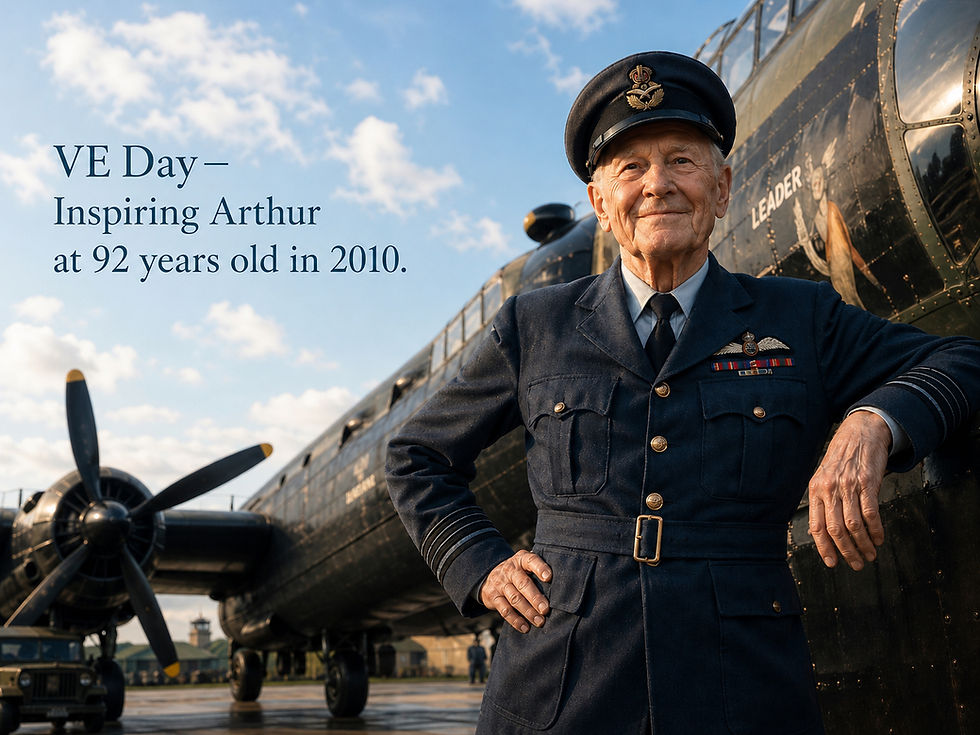
Why This Matters on VE Day
On 8th May, we remember the end of the war in Europe.
But it is often the quieter stories that stay with you.
Arthur was not trying to be remembered.
He just got on with things.
And years later, walked into a clinic at 92 with better movement than most people half his age.
A Small Note
Stories like Arthur’s are becoming rarer.
There are fewer people now who can tell them first-hand, and fewer who quietly carry that kind of experience without ever making a fuss about it.
In honour of Arthur, and the thousands like him, the RAF Benevolent Fund supports RAF veterans and their families.
If this story has stayed with you, it is one way to give something back.
Quietly. In the same spirit.
Final Thought
Arthur never spoke about discipline or mindset.
But you could see it in how he lived.
In how he approached the war.In how he looked after himself afterwards.
No fuss. No overthinking.
Just doing what needed to be done.
And then doing it again the next day.
Because in the end, whether it is flying through flak or keeping your body moving into your 90s, the principle is not that different.
Consistency does the work.


Comments