top of page

Chronic Lower Back Pain & Pelvic Imbalance Treatment in Horsham

QL Dysfunction, Pelvic Tilt & Long-Term Spinal Compensation
Chronic lower back pain in Horsham often stems from quadratus lumborum dysfunction and pelvic imbalance.
Discover the real mechanical causes and how targeted soft tissue therapy restores alignment.
Why Lower Back Pain Is Rarely “Just the Back”
Most clients walk into my clinic in Horsham pointing to their lower back and saying, “It’s here.”
But pain location is not always pain origin.
Chronic lower back pain is frequently driven by pelvic asymmetry and quadratus lumborum (QL) dysfunction, not disc damage, not random strain, and certainly not just “getting older.”
The QL acts like a stabilising guy rope between your ribcage and pelvis. When it shortens or over-recruits on one side, the pelvis tilts. Once the pelvis tilts, everything above it compensates.
That’s when things get interesting.
The Quadratus Lumborum:
The Silent Instigator
The QL attaches from the iliac crest to the 12th rib and lumbar transverse processes. Its role?
-
Lateral flexion
-
Pelvic stabilisation
-
Spinal load sharing
When chronically shortened on one side:
-
The pelvis hikes
-
The lumbar spine side-bends
-
The opposite side overstretches under load
Clients often feel pain on the opposite side of the tight QL due to compensatory strain.And this doesn’t stay local.
See Lateral Knee & IT Band Referral Patterns

Pelvic Tilt & The Domino Effect
A lateral pelvic tilt changes:
-
Lumbar loading patterns
-
Sacroiliac joint stress
-
Hip rotation mechanics
-
Gait symmetry
Now the body tries to “correct” this visually. The shoulders elevate asymmetrically. The head side-bends to maintain eye level.
Over time this becomes:
-
Thoracic tension
-
Neck tightness
-
Head-forward posture
(We explore that further in the Shoulder Compensation & Thoracic Tension pillar page.)
Long-Term Spinal Strain
What Happens If It’s Ignored?
Chronic asymmetrical loading can lead to:
-
Facet joint irritation
-
Recurrent muscle guarding
-
Disc stress under uneven compression
-
Reduced shock absorption
Is every QL imbalance heading for spinal prolapse?
No.But chronic unmanaged asymmetry increases mechanical stress over years.
The spine tolerates load.
It doesn’t tolerate imbalance forever.
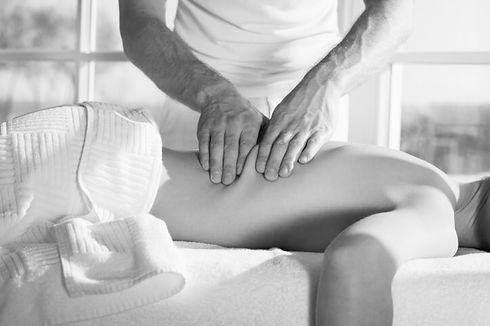
Why Massage Alone Isn’t Enough
But Targeted Soft Tissue Therapy Is
Generic massage relaxes tissue temporarily.
Clinical soft tissue therapy does something different:
-
Assesses load asymmetry
-
Identifies dominant vs inhibited structures
-
Releases shortened tissue
-
Reinforces mechanical balance
Treatment may include:
-
QL release
-
Gluteal rebalancing
-
Thoracolumbar fascia mobilisation
-
Shoulder decompression (because compensation lives there too)
And yes — strengthening and corrective strategies matter.But you cannot strengthen around chronic restriction.
See Understanding Frozen Shoulder

FAQ: Chronic Lower Back & Pelvic Imbalance
-
Is pelvic tilt common?
Very. Mild asymmetry is normal. Chronic loaded asymmetry is not.
-
Why does one hip feel tighter than the other?
Asymmetrical loading can cause one hip to overwork while the other underperforms. The tighter side is often the stabilising side working harder to maintain alignment.
-
Can pelvic imbalance affect my posture?
Absolutely. If the pelvis tilts, the shoulders and head often adjust to keep the eyes level. Over time this can contribute to shoulder elevation, neck tension, and forward head posture.
-
Can this cause knee pain?
Yes — especially lateral knee irritation. See the pillar on Lateral Knee & IT Band Referral Patterns.
-
Does sitting all day make it worse?
Prolonged sitting can reinforce asymmetrical patterns, especially if you habitually lean to one side or cross the same leg repeatedly. Static posture increases adaptive shortening over time.
-
Can strengthening alone fix pelvic imbalance?
Strengthening is important, but strengthening around a restricted or dominant pattern can reinforce asymmetry. Releasing overactive structures and restoring balance first improves results.
-
Does age cause pelvic imbalance?
Age influences tissue resilience and recovery, but imbalance is more often driven by habit, occupation, previous injury, and repetitive loading patterns.
-
What happens if pelvic imbalance is ignored?
Over time, the body adapts more deeply into the pattern. Compensation increases, range of motion reduces, and recurring pain becomes more frequent.
-
Can this affect breathing?
Yes. The quadratus lumborum attaches to the 12th rib. Chronic asymmetry can subtly influence rib positioning and breathing mechanics.
bottom of page